






When it comes to your home, siding isn’t just about looks—it’s your first line of defense. It protects your house from the elements, helps control energy efficiency, and plays a...
Indoor Fall Home Maintenance Checklist
By Mike Holmes
Mike’s Advice / Home Renovation
Wednesday, September 23rd, 2026 @ 9:31am
Fall Home Maintenance Checklist: Get the Inside of Your Home Ready for Winter
Small home maintenance jobs have a way of turning into big problems when they’re ignored. I always tell homeowners to maintain their homes from the outside in, because the exterior protects everything inside. But once you’ve checked your roof, gutters, foundation, siding, windows and exterior drainage, it’s time to look inside. Fall is the perfect time to prepare your heating system, check your insulation and ventilation, look for moisture problems and make sure the safety systems in your home are working before winter arrives.
And I love a checklist. You don’t have to tackle everything in one day. Put seasonal reminders in your phone or calendar and make home maintenance part of your regular routine.
Here is my indoor fall home maintenance checklist to help get your home ready for winter.
Interior Maintenance Checklist
- Check for drafts around windows and doors
- Inspect weatherstripping and caulking
- Check insulation and look for attic moisture
- Have your heating system inspected and serviced as required
- Check or replace HVAC filters
- Test smoke alarms and carbon monoxide alarms
- Inspect your basement and crawl spaces for water or moisture
- Check basement floor drains
- Monitor indoor humidity
- Inspect and maintain your HRV or ERV
- Make sure bathroom and kitchen exhaust fans work properly
- Test GFCI receptacles
- Clean your dryer lint system and inspect the exterior dryer vent
- Inspect and maintain humidifiers
- Check your water heater
- Start a long-term radon test if you haven’t tested your home
Check for Air Leaks, Drafts and Missing Insulation
You pay to heat your house, so you don’t want that heat escaping through gaps and poorly insulated parts of your building envelope.
Air sealing and insulation work together to improve comfort, energy efficiency and durability.
In the fall, pay attention to areas around:
- windows
- exterior doors
- attic hatches
- plumbing and electrical penetrations
- basement rim joists
- other openings through the building envelope
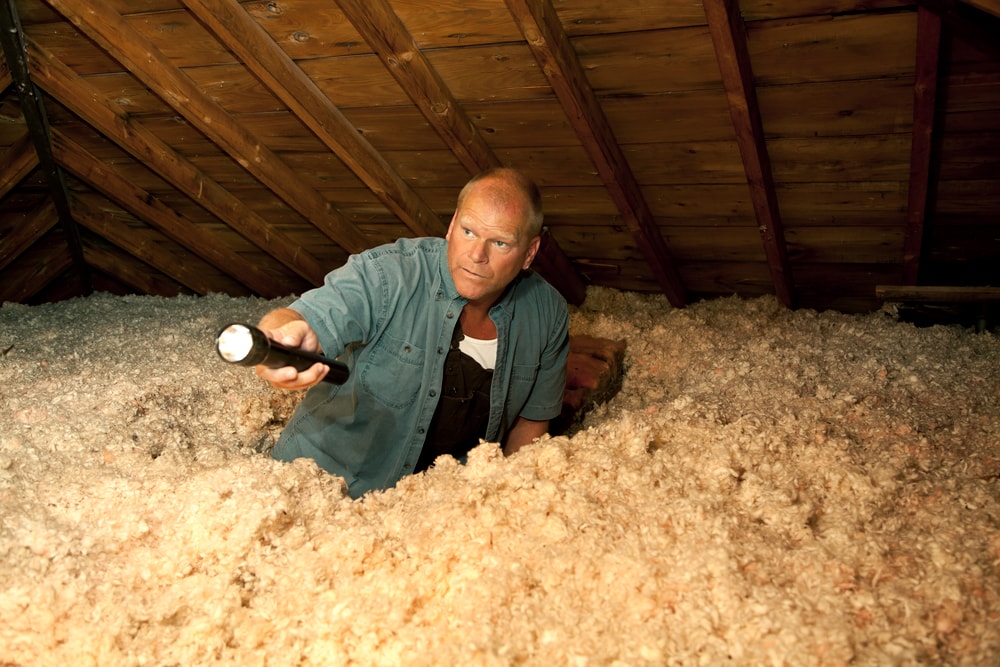
I’m a big fan of spray foam, which has a lot of insulating power. Remember, this is a project that’s best left to the pros.
Insulation and sealing also help control your home’s thermal condition by creating a balance within the building. It can also help reduce any noise pollution.
If you feel a draft, find out where it’s coming from rather than simply turning up the thermostat.
RELATED:
Check Weatherstripping Around Windows and Doors
Weatherstripping doesn’t last forever.
Inspect it around windows and exterior doors in the fall. Look for pieces that are cracked, flattened, loose or missing.
Different applications require different types of weatherstripping, so use the product designed for the specific window or door.
Also inspect caulking around openings. If exterior sealant has failed, deal with the cause from the outside rather than trying to hide a water problem with an interior bead of caulking.
Inspect Your Attic for Moisture and Insulation Problems
Your attic can tell you a lot about what’s happening inside your house.
Look for:
- water staining
- damp or compressed insulation
- signs of mould
- frost during colder weather
- damaged roof sheathing
- pest activity
- blocked ventilation openings
Your attic needs the right combination of insulation, air sealing and ventilation.
Don’t assume adding more insulation automatically solves every problem. If warm, moist indoor air is leaking into your attic, you need to identify and fix those air leaks too.
If you find significant moisture, mould or signs of a roof leak, bring in the appropriate professional.
Inspect Foundation Cracks From the Inside —But Fix Water Problems at the Source
Fall is also a good time to inspect unfinished basement walls and floors.
Small cracks in concrete aren’t automatically a structural emergency, but don’t ignore cracks that are growing, leaking, changing direction or accompanied by movement.
If you’re seeing water through a foundation crack, remember my rule:
Fix it from the outside in whenever possible.
Simply patching the inside may hide the symptom without addressing why water is reaching the foundation.
Large, changing or suspicious cracks should be assessed by a qualified professional.
RELATED:
There are two types of weather stripping; nail-on and peel-and-stick. Nail-on weather stripping is typically used with wooden frames but you can also use peel-and-stick. Peel-and-stick stripping is either foam or felt and is easy to apply.
Inspect the House Heating System and Get Your Heating System Ready for Winter
Don’t wait until the first freezing night to discover your furnace or heat pump isn’t working properly. Fall is a good time to have your heating system inspected and serviced according to the manufacturer’s recommendations.
A qualified HVAC professional can check system operation, airflow, controls and other components and identify issues before the system is working hard all winter.
If you have fuel-burning heating equipment, proper installation, ventilation and maintenance are particularly important because incomplete combustion can produce carbon monoxide.
Check Your HVAC Filter
Check your furnace, heat pump or air-handler filter regularly and replace or clean it according to the equipment and filter manufacturer’s instructions.
I don’t like giving homeowners one replacement schedule for every house because filters, equipment, pets, occupancy and indoor conditions differ.
The important thing is to check it regularly.

I recommend changing your filters at least every 3 months, minimum. In fact, place with clean filters at the start of every season so it’s easy to remember.
A heavily loaded filter can restrict airflow and make your HVAC equipment work harder.
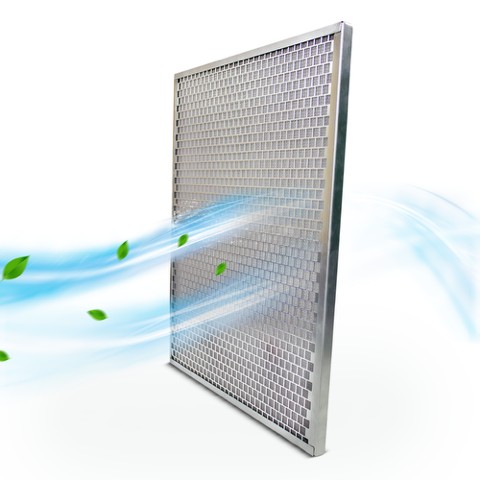
The DistinctAir furnace filter traps and destroys up to 99.9% of airborne particles – including bacteria, pollen, allergens, dust and pet dander.
What About Heat Pumps?
Heat pumps can provide both heating and cooling, so unlike a conventional central air conditioner, the outdoor unit may continue running throughout winter.

Heat pumps can provide both heating and cooling
Keep the area around the outdoor unit clear and watch for excessive snow or ice buildup.
Most importantly: do not wrap or cover an operating heat pump for winter.
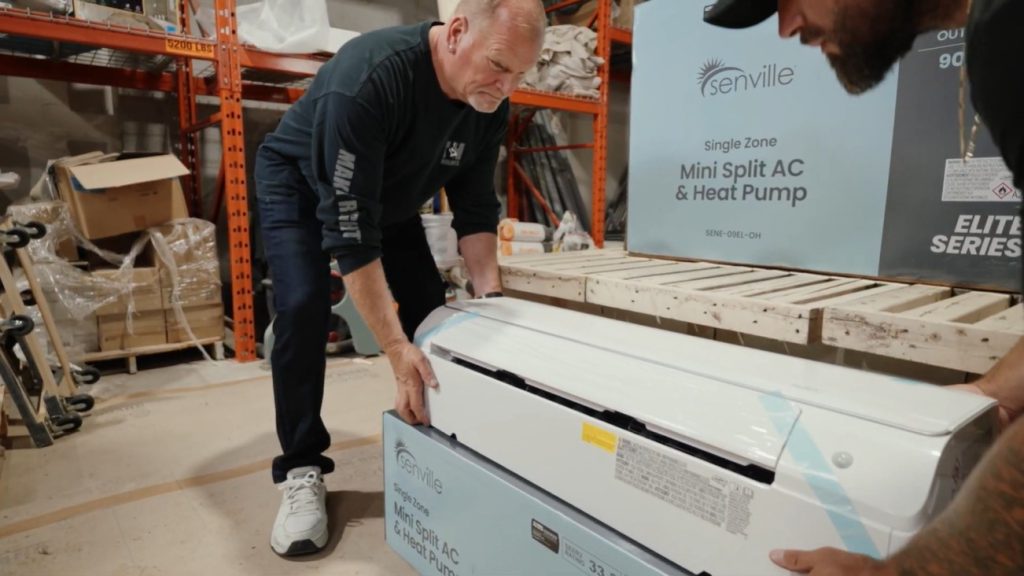
Unboxing Senville Mini Split AC & Heat Pump. Senville offers high-efficiency heating and cooling solutions designed to deliver reliable comfort across a wide range of spaces and climates.
Have the system maintained according to the manufacturer’s recommendations and get a qualified HVAC contractor involved if you notice unusual ice buildup, noise or performance problems.
RELATED:
Test Your Smoke and Carbon Monoxide Alarms
Every home needs smoke and carbon monoxide alarms, in order to keep you and your family safe. It’s also the law. Both carbon monoxide and fire alarms can be hardwired or battery-operated. CO2 alarms also come in plug-in versions.
This is one of the most important items on your fall maintenance checklist.
Smoke Alarms
Test your smoke alarms every month using the test button.
In Ontario, working smoke alarms are required on every storey of a home and outside sleeping areas.
Check the manufacturer’s instructions for battery replacement and alarm service life. Smoke alarms don’t last forever, so check the manufacture date and replace expired units.
And never remove a battery because nuisance alarms are annoying.
Fix the cause or install the appropriate alarm in the appropriate location.
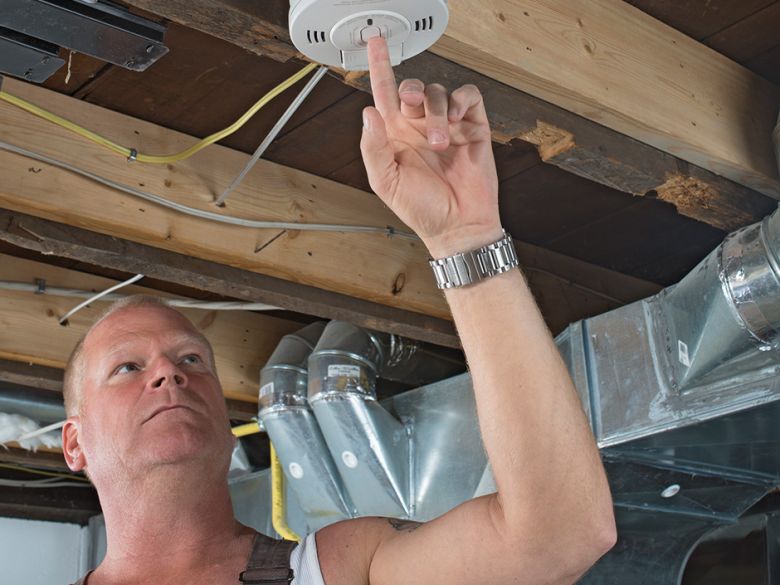
Replace your smoke alarm batteries every time you change your clocks. You will also want to test them monthly to make sure they’re working
Carbon Monoxide (CO) Alarms
Carbon monoxide is not carbon dioxide. CO is an invisible, odorless gas that can be produced when fuels such as natural gas, propane, oil, gasoline or wood do not burn completely. Ontario updated its CO alarm requirements in 2026. For houses where CO alarms are required, alarms must be located adjacent to each sleeping area and on every floor of the home. Follow the manufacturer’s instructions for placement, testing, maintenance and replacement.
And remember: a CO alarm is a backup safety device. It doesn’t replace properly installed and maintained fuel-burning equipment.
Check Your Attic, Basement, And Crawl Spaces for Leaks and Moisture
Although it may appear to be just empty space, an attic can tell you a lot about your home and any problems that need to be fixed, so make sure you inspect your attic regularly.
Basements and crawl spaces deserve extra attention before winter.
Look for:
- damp walls or floors
- water staining
- musty odours
- visible mould
- condensation
- plumbing leaks
- foundation water intrusion
- signs of pests
If you find mould, don’t just clean the surface and assume the job is done.
You need to figure out where the moisture is coming from and fix that problem, or the mould can return.
Spring and fall are good times to schedule an inspection, especially if it’s raining. Even without a professional inspection homeowners can do a quick visual inspection to look out for black mould, mouse droppings, and water stains.

Most commonly, the presence of mould will cause a musty smell. Mould in the air outside can also attach itself to clothing, shoes, and pets, and be carried indoors.
Airflow, measuring insulation, and taking into account proper ventilation are all elements that need to be managed for optimal conditions in your attic, basement, or crawlspace.
RELATED:
Check Your Basement Floor Drain
Don’t wait until you smell sewer gas to think about your basement floor drain. Many floor drains have a trap that holds water and creates a barrier between your home and the sewer system. If a floor drain isn’t used regularly, that water can evaporate. If the trap is dry, adding clean water can restore the water seal.
Your drains may need maintenance if you are experiencing standing water in sinks, bathtubs or showers, gurgling in toilets, or strange sounds coming from sinks. When water is coming up via a drain, you need to get your drain checked.
Persistent sewer smells, slow drainage, gurgling or water backing up through a floor drain should be investigated by a qualified plumber. I would remove the old recommendation to automatically clean a sewer drain every 18 to 22 months. Plumbing systems and conditions vary, and symptoms are more useful than an arbitrary cleaning schedule.
RELATED:

Keep Indoor Humidity Under Control
Moisture is created every day in our homes through cooking, cleaning, doing laundry, taking showers or baths, plants, or just breathing. The amount of moisture or water vapour in your home can be determined by measuring the humidity. The ideal humidity or moisture level in a home should be between 30 – 50%, depending on a number of factors. A small hygrometer is an inexpensive and simplest way to keep track of relative humidity.
When humidity levels are too high or too low this can lead to a number of issues for your home and your family. Some signs that you have humidity problems include, noticing moisture or condensation on your windows. You may even notice puddling on your window sills. Typically, the warmer the home, the more moisture is generated.
Left untreated there is the potential for mold and rot damage throughout your home. Running a dehumidifier will help get rid of some of that moisture but depending on the circumstances you may need something more effective, like an efficient air exchange system. Installing an ERV or HRV could have a dramatic effect on your indoor air quality as they continually exchange the indoor air with fresh outdoor air.
Don’t just keep wiping away the condensation. Figure out why you have excess moisture.

Installing a Panasonic ERV (energy recovery ventilator) in my home.
In air-conditioned homes, (humidity levels outside are higher than inside), your ERV system will limit the amount of moisture coming into your home. In humidified homes, (when the humidity level is low in winter), ERV systems limit the amount of moisture expelled from your home.
Inspect and Maintain Your HRV or ERV
I’ve talked a lot about HRVs and ERVs, as they are great additions to any HVAC system, and when well-maintained they will perform optimally, helping your indoor air to stay healthy and moisture level maintained. An ERV also transfers some moisture between the incoming and outgoing air streams, which can help manage indoor conditions.
I’ve had Panasonic ERVs installed on our projects and in my own home because proper ventilation is a big part of building a healthy home.
But an ERV or HRV needs maintenance.
Inspect:
- filters
- exterior intake and exhaust hoods
- the heat- or energy-exchange core
- condensate drainage where applicable
- controls and warning indicators
Different systems use different filters, and not every filter is washable. Follow the maintenance instructions for your specific model.
If your unit is a Panasonic system, follow the filter-check, cleaning and replacement schedule specified for that particular model.
A dirty ventilation system can’t do its job properly.
Make Sure Bathroom and Kitchen Exhaust Fans or ventilation Fans Work
Bathroom and kitchen ventilation removes moisture, odours and pollutants at the source.
First, make sure the fan actually turns on.
A simple tissue test can give you a basic indication that a bathroom fan is drawing air: hold a tissue against the grille and see whether the fan holds it in place.
But that’s only a quick screening test.
A fan can create suction at the grille and still have problems with its ductwork. Exhaust ducts need to terminate outside, not inside an attic, wall or ceiling cavity.
Check exterior terminations as well and make sure they aren’t blocked.
Bathroom Exhaust Fans
If your bathroom stays steamy for a long time after showers or you regularly see heavy condensation, your fan may be undersized, dirty, poorly ducted or not being run long enough. A qualified contractor can determine the appropriate fan capacity based on the bathroom and installation. If an old fan is noisy or underperforming, replacing it with a quieter, efficient model can make a big difference because a fan only helps when people actually use it.
Panasonic’s ventilation fans are products we’ve installed on our projects, and quiet operation is something I particularly like because homeowners are more likely to run a fan that isn’t driving them crazy.
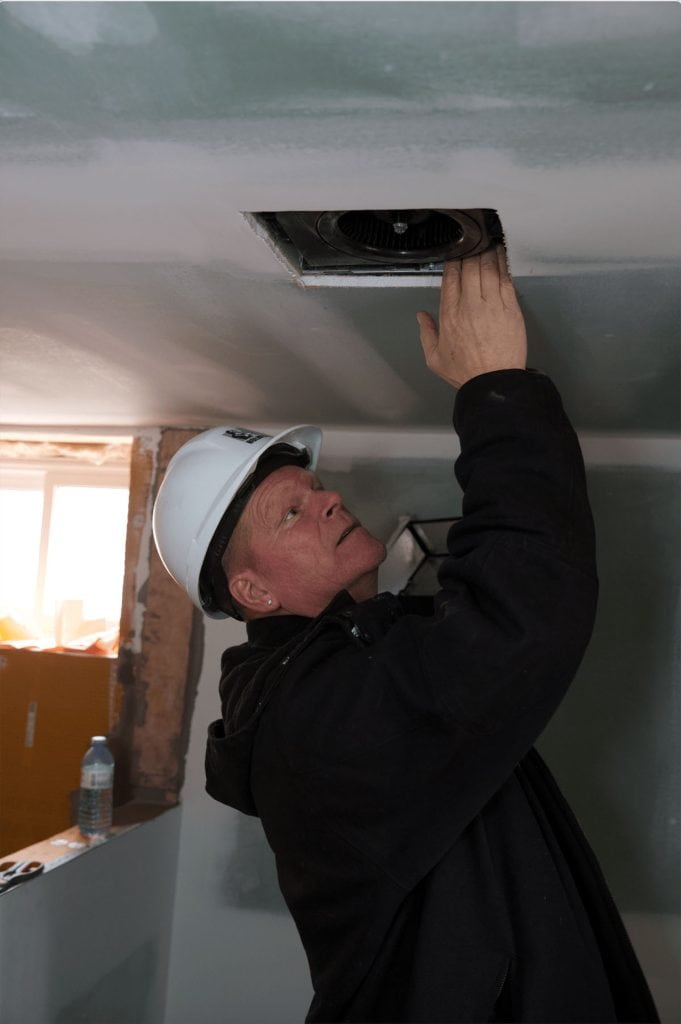
Panasonic WhisperValue Fan Installed At Job Site .
Kitchen Range Hoods
Use your range hood when you’re cooking. The hood should capture cooking moisture and pollutants and exhaust them outdoors where required. Don’t assume every kitchen needs the same CFM rating. Hood size, cooking appliances, duct design and local requirements all matter. High-capacity exhaust systems can also depressurize a tightly sealed house and, in some situations, contribute to back drafting of naturally vented combustion appliances.
If you’re installing a powerful range hood, have the ventilation and makeup-air requirements properly assessed.

A powerful range hood was installed in a Custom kitchen from Holmes on Homes Series.
If you have an old fan, I would recommend replacing it with a new more efficient, and powerful fan, like for ENERGY STAR® ventilation options. For bathrooms up to 100 square feet in size, you should have an exhaust fan provide a minimum of 1 cubic foot per minute (CFM) per square foot of floor space. I’d go higher—especially in a larger bathroom, or one with several fixtures or a jetted bathtub.

Kitchen by Holmes Approved builder, Habitations CBA
If you have any doubts, consult with a professional or your contractor to find the best solution for your home.
RELATED:
What Is The Tissue Test To Check Your Ventilation System Is Working
I’m a big fan of the tissue test, as it is an easy and simple way to get an idea that your fan is working correctly. Take a tissue and hold it up to the fan grate, if the tissue sticks to the grate, then you know the fan is sucking the air out of the room. You can also use baby powder, give the bottle a squeeze and if the powder gets sucked up then your fan is working properly.
RELATED:
Check and Reset Ground Fault Circuit Interrupter – GFCI
A ground fault circuit interrupter outlet (GFCI outlet) is a safety feature created to cut the circuit if there is an imbalance of incoming and outgoing current. The GFCI is a device that’s used to protect a person from electrical shock near water.
RELATED:
What Are Ground Fault Circuit Interrupters (GFCIs) And How Do They Work
How To Test a GFCI Outlet
On your GFCI outlet, there should be two rectangular buttons, labeled “TEST” and “RESET.” To test your GFCI all you have to do is press the test button. What this will do is simulate a short to ground or neutral. You should then hear a snap sound and see the RED RESET button pop, as that trips the outlet and cuts off the power.
Plug a lamp into each half of the outlet to confirm that the power has been turned off. The devices should not turn on. After confirming that the safety function is working properly, press the reset button to restore power to the outlet. Make sure to always follow the manufacturer’s testing schedule recommendations —sometimes these can be monthly.
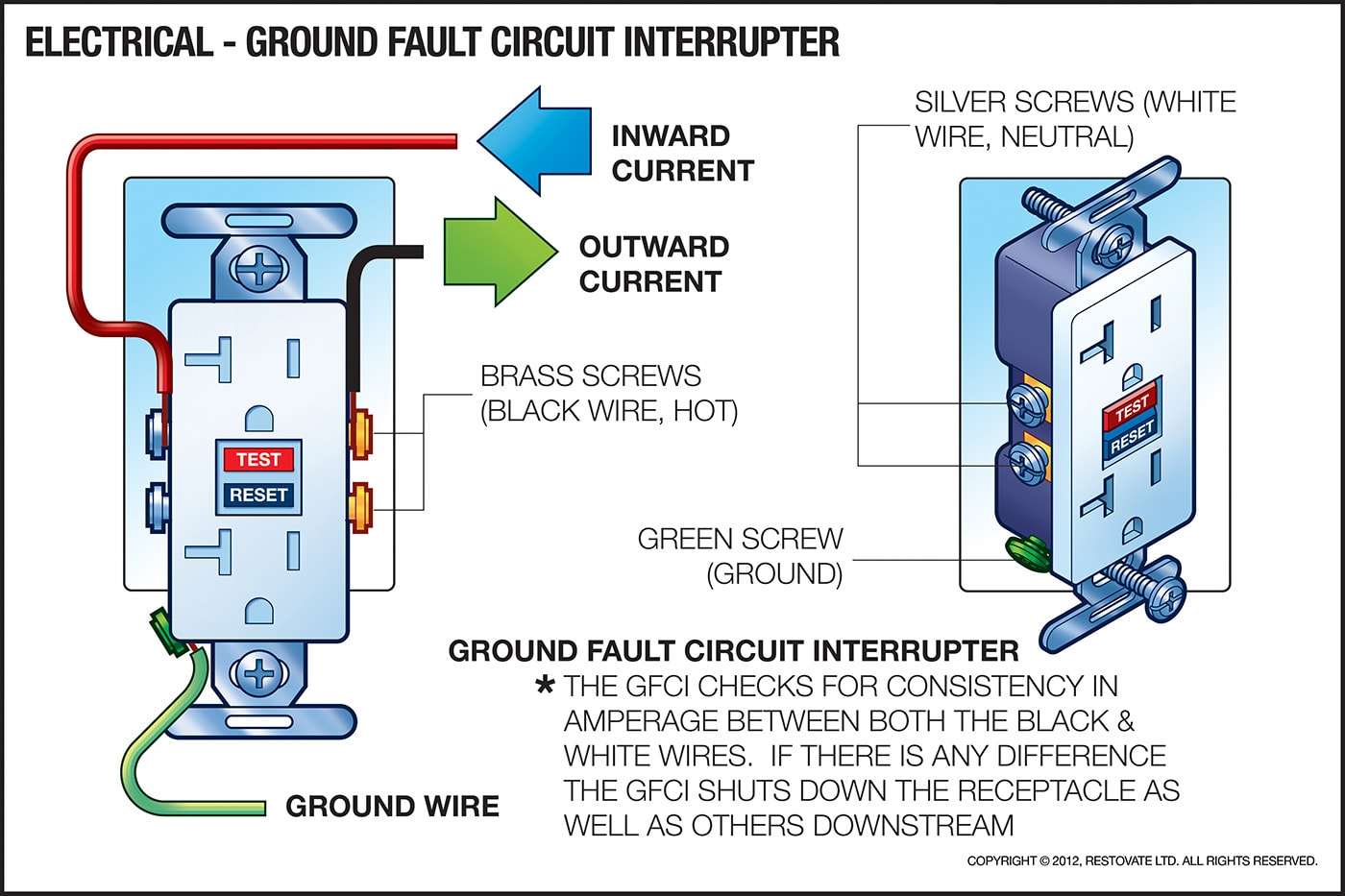
How do GFCIs work Illustration
What Happens If The GFCI Will Not Reset
If the GFCI won’t reset or the “test” button doesn’t come out when you press it, there might not be electricity going to the GFCI or the GFCI could be damaged. Unsafe current leaks may exist somewhere on the circuit if the “reset” button trips repeatedly when you click it.
If you have any doubts, contact a Licensed Electrical Contracting business to do some troubleshooting. It may be a faulty outlet or it may be something more serious, but it’s always best to be safe and get it checked by a pro.
Clean Your Dryer Vent
Here’s another maintenance job homeowners sometimes forget.
Lint doesn’t only collect in the lint screen.
Inspect and clean the dryer exhaust system according to the appliance manufacturer’s instructions and make sure the exterior vent isn’t blocked.
A restricted vent makes the dryer work harder and lint buildup can become a fire hazard.
Never exhaust a dryer into your home, attic, garage or another enclosed space.
And clean the lint screen regularly.
RELATED:
Clean-Up List
- Clean the internal parts of Air Conditioners
- Inspec and clean your humidifier and water heater
Clean the internal parts of Air Conditioners
Before you cover your AC for the season, make sure the area surrounding it has been cleared of debris, like leaves and twigs, and give it a wipe-down. Cover your air conditioner unit with a protective waterproof cover to help insulate and protect your unit from cracking, debris, and the elements. A waterproof tarp secured with bungee cords is a good alternative if you’ve misplaced the cover.
You should also call someone to inspect and service your AC. This will include the replacement of filters, inspection of indoor and outdoor coils, condenser pump, thermostat, and general cleaning of the unit.
How To Maintain AC Window Units
Window units should be removed, cleaned and checked for any damage or wear according to the manufacturer’s instructions. Coils can be cleaned by using compressed air. Use warm water and mild detergent or vinegar to do a wipe-down to remove any dirt from the condensation pan at the base of the unit.
The best place to store window units is in a basement or utility room, and make sure the unit is thoroughly dry before storing. If you must leave the unit in the window during the off-season be sure to use an air conditioner cover that is specifically designed for external use and protects it against the elements.
Clean Your Humidifiers And Water Heaters
Clean Humidifiers
For portable humidifiers, vinegar can be used for cleaning. However, you should not run the humidifier with vinegar in it, as it can irritate your eyes, nose, throat, and lungs. Unplug the unit, fill the base of the humidifier with 1 cup of water and 1 cup of white vinegar and leave it to sit for an hour. The vinegar is a natural cleanser and it’ll help loosen any residue and disinfect the unit.
Check the manufacturer’s guidelines on replacing or cleaning your filter – this should be done regularly.
A whole-home humidifier is installed directly into your HVAC system and brings humidity into your home via ductwork. It is controlled much like your thermostat, providing a consistent level of humidity all year long.
Moisture gets into your home via a water panel. This water panel needs to be replaced or cleaned on a regular basis as it will get clogged with minerals and particles from your water supply, thus affecting the performance of your unit.
Water Heater
To remove the buildup, experts often advise draining and flushing your water heater at least once a year. This makes sure that your system is supplying your home with the most, hot water possible. Check for any leaks around the hot water heater’s base. If you do find a leak, it could be for a couple of reasons, like a loose drain valve, a defective installation, or insufficient maintenance.
Tankless water heaters on the other hand supply hot water on demand so you never have to run out of hot water or run your system when not needed —I love it! It can last for many years and save on energy costs if they are installed and maintained properly.
RELATED:
Other Home Maintenance Items
Organize Your Garage
I find with the change of season there is always an opportunity to do a quick declutter and reorganization of your garage. We use different items in different seasons and there’s always going to be a bit of fallout from it.
Pack up your summer items, and sort them properly so you can make room for your fall and winter items. You might be able to even fit your car so that you’re not clearing the snow all winter. It can get tedious! Give your floor a sweep and clean, drain and store outdoor hoses, check your garage door, and think about some additional storage solutions.
RELATED:
Regular maintenance is key to having a happy and healthy home inside and out. Always review your checklists regularly, and if something doesn’t look right, tend to it promptly. In the end, you will be glad you did!
READ MORE:
Fall House Exterior Maintenance Checklist
Related Articles

What is The Best Exterior...
When it comes to your home, siding isn’t just about looks—it’s your first line of...

Trick Or Threat – How...
Halloween Home Safety Tips: How to Prepare Your Home for Trick-or-Treaters Halloween is one of...

10 Heat Pump Questions Homeowners...
Heat Pump FAQ Heat pumps have been around for awhile now but recently they've been...